
The Scale Went Down. What Happened to Your Strength?
The scale barely separated the two groups in a new tirzepatide study. Their strength tests told a very different story.
For informational purposes only. This article has not been reviewed by a doctor or medical professional and is not medical advice or guidance.
The jeans fit better. The belt has moved a notch. But you’re halfway up the basement stairs with a bin of hockey gear and you notice the thing you haven’t been tracking: it feels heavier than it used to. That doesn’t tell you how much muscle you have. It does give you a better question than “How much more can I lose?” What do you want your body to be able to do while your weight changes?
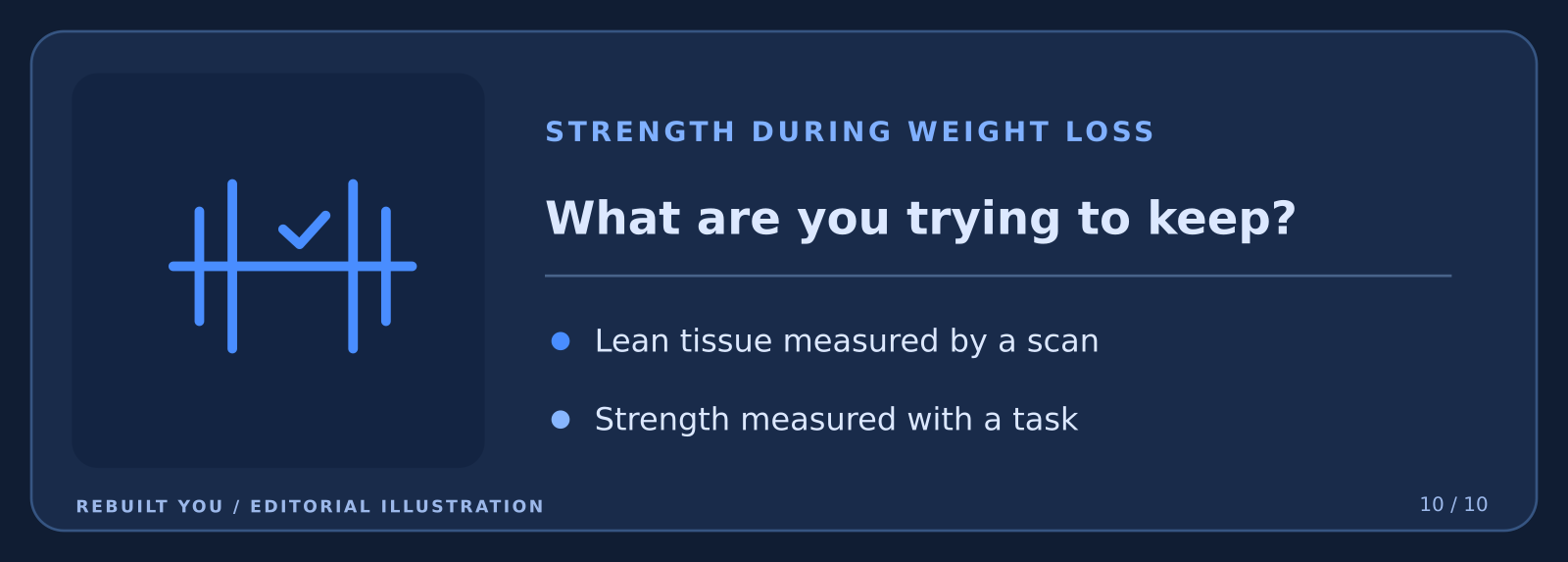
A 2026 randomized study tested a version of that question in adults taking tirzepatide. The group that did supervised resistance exercise lost about as much weight as the group that continued usual activity. They lost less lean tissue, and they got stronger on the movements researchers tested. Those are three different findings. Put together, they show why the scale is a poor scoreboard for the whole project.
Same medication, nearly the same scale result
In the T-REx trial, published in Nature Medicine, 120 adults aged 50 to 70 with obesity or overweight with a weight-related health condition were assigned to usual activity or a supervised resistance training program. Both groups received tirzepatide, a medicine acting on the GIP and GLP-1 receptors. The study lasted 40 weeks and included men and postmenopausal women. The exercise group was offered three centre-based sessions a week. This was a comparison of adding supervised training to treatment, not a comparison of lifting alone against medication, and not a test of every drug commonly described as a GLP-1.
By the end, both groups had lost an average of about 22 kilograms of body weight. The difference in weight loss was not statistically clear, and neither was the difference in fat loss. The result that separated the groups was in lean soft tissue: an estimated 4.67 kilograms lost with usual activity versus 3.57 kilograms with resistance training. The estimated difference was about 1.09 kilograms in favour of the training group, with a 95% confidence interval of 0.43 to 1.75 kilograms.
Research Note
Read the resistance-training trial. Its comparison was tirzepatide plus supervised resistance exercise versus tirzepatide with usual activity. Lean tissue on a scan and strength measured in a task are different outcomes.
Notice what the numbers don’t say. The training group did not keep every kilogram of lean tissue. And the trial doesn’t tell us that adding resistance work makes weight loss faster. It says the composition of the weight change differed even when the scales told almost the same story.
Lean tissue, muscle size and strength are not synonyms
The trial used a DXA scan for its lean soft tissue measurement. That reading includes muscle and other non-fat soft tissue. It is not a direct weigh-in of skeletal muscle alone. The team also measured limb lean tissue, which is more informative about muscle than whole-body lean tissue but is still not the same measurement as how much force you can produce. If a headline turns every kilogram of lean tissue into a kilogram of muscle, it’s erasing that distinction.
The researchers separately tested upper- and lower-body strength. Bench press, lat pulldown and knee-extension strength declined on average in the usual-activity group and increased in the resistance-training group. For example, the average change in measured knee-extension strength was about six kilograms up with training versus about four kilograms down with usual activity. That’s a test result, not a forecast of who can carry their tools farther or play a second soccer game on Sunday. But it answers a more useful question than a scan alone: what happened to the force people could produce in those exercises?
It’s possible to get better at lifting while still losing some lean tissue. That’s exactly why it matters that the team measured both. Changes in skill and coordination on exercises may contribute to measured strength; the study doesn’t tell us which improvements would carry over to every real-world task. It also didn’t establish that the program prevents future falls, disability or injury. Those are longer-term questions, not implied benefits you can attach to the weigh-in.
The study had a training room. You have Tuesday.
Most of us do not have the conditions of a research trial. Someone else did not set aside three sessions in a centre, supervise the lifts and check we came back. This group was screened and relatively inactive before enrolment. It excluded people with diabetes and established cardiovascular disease and followed participants for 40 weeks, not years. The drug manufacturer supplied tirzepatide and reviewed the protocol; the paper reports that the investigators independently collected and analyzed the data. Attendance was high, and it’s not clear what results would look like with a less-frequent program, a quick home routine or someone already accustomed to lifting heavy. That doesn’t make the study irrelevant. It makes the part you can reasonably borrow smaller and more useful: include what you want to stay able to do in the discussion from the start.
That might be getting up from the floor without bracing on the couch, carrying the grocery haul from the car without a second stop, or feeling steady when you step off the ice. Pick something you can describe. “Strong enough to keep up” means more when you can say what keeping up looks like in your life. It also gives a clinician or qualified exercise professional something to work with besides a target weight.
If you already have a routine, write down a couple of movements you do consistently and how they feel at a comparable effort. If you’re just starting, the first win may be finding an appropriate version of resistance work that you can repeat. One greater load on one good day isn’t a trend, and one terrible session after a work trip doesn’t mean the plan stopped working. Look for a pattern under ordinary conditions rather than testing yourself whenever the scale changes.
Bring two numbers and one sentence to the next check-in
The first number can be the measure your care team already follows. The second can be one consistent training or function observation: the load you normally carry on a familiar exercise, or the number of times you had to put the gear bag down on the same flight of stairs. The sentence is the context: “I’m happy with this part of the change, but I’ve been feeling weaker,” or “I can still do my usual session, but I’ve been struggling to eat enough.”
If persistent nausea, poor intake, lightheadedness or unusual weakness is changing what you can do, bring it to the prescribing team rather than using a tougher workout to make up for it. Ask what suitable training and food support might look like, and what would be a reason to adjust the plan. Don’t change a prescribed medicine to chase a result from a research trial.
Weight can be one measure of progress. The ability to do something you were worried about losing is another. When both matter to you, track both. The scale cannot tell you what happened on the stairs.
Sources
Get the weekly digest
One email a week. Unsubscribe anytime. Privacy Policy.
More from Rebuilt You

Can GLP-1 Medicines and FSH Help Male Fertility? What the Research Hasn’t Tested Yet
The paper behind the GLP-1 and FSH headline proposes a combination. It did not test one. Here’s what separate human and animal studies measured, and what to ask about when fertility matters.

Low Testosterone After 40: What Your Blood Pressure and Blood Sugar Can Add to the Conversation
A study found a link between several metabolic health issues and a pattern of low testosterone. Here’s why LH, repeat testing and your broader health belong in the same conversation.
A Drug Went After the Receptor Prostate Cancer Uses. What Happened Next?
An experimental drug targets the androgen receptor. The headline number came from 20 men with specific tumour changes. Here’s what that result means, and why it isn’t the same as proof of longer survival.

Testosterone Therapy After 40: What Two Big Trials Actually Found
One major study asked whether men felt better. The other watched for heart attacks and strokes. Neither gives a yes-or-no answer to every promise made about testosterone after 40.
Discussion
Loading comments…